
Have you ever wondered why your avoidant won’t admit that they’re attached to you?
Why do they struggle so much with admitting their feelings?
What’s preventing them from saying “You’re the one for me”?
Isn’t being attached and connected a good thing? Something they would benefit from and should want for themselves and your relationship?
Hi, I’m Gabriel, and as a former avoidant, I’m going to explain to you WHY avoidants won’t admit their attachment to you.
Because once you understand their reasons for being so guarded or secretive, you will see them in a different light, relate to them in a different manner and, by extension, get more of the connection and closeness from them that you desire.
My Story
I’d like to explain this through my own avoidant-to-secure journey.
It’s a little vulnerable, so go easy on me.
When my wife Karolina and I initially met, there was without a doubt a very strong attraction for me, BUT I also had a lot of uncertainty and doubt, as avoidants do.
She, on the other hand, had an anxious attachment style at the time. So the mixed bag of her anxious tendencies and my avoidant ones were of course a recipe for… complications in our relationship.
On the one hand, I was quite transparent from the get go, about not knowing what I wanted and took space from time to time.
But on the other hand, I arranged to meet and made thoughtful gestures every once in a while.
This and many other mixed messages I was sending led to a lot of confusion for Karolina. So that she was left wondering “how does he really feel about me, does he care, is he becoming as attached as I am?”
So why didn’t I just simply tell her how I felt? What was my excuse? What were my reasons?
Unfortunately, there is no one simple answer, but rather layers of reasons that made me act this way.
I Was Quite Detached From My Own Feelings
This may be a trait more typically found in avoidant men, and in my case, it was thanks to a not-so-ideal childhood where any emotions I had that did not fall in alignment with what my parents deemed appropriate or acceptable were either ignored, shamed, met with aggression, and shut down by any means necessary.
And guess what one of those forbidden feelings was?
Attachment. Being attached. Getting attached. Seeking connection and closeness.
On the flip side, distance, detachment, and emotional isolation were regarded as a good thing and a sign of strength.
So after decades of being related to this way, I became detached from and unaware of my own feelings.
I then carried this conditioning, this template on how to relate to my own emotions, all the way into my adult life. Which meant I was relating to Karolina in this detached and distant way.
It’s important to get that the oppression of attachment in childhood will literally make your avoidant unaware of how they feel towards you in your present-day relationship.
Because all they have to reference, all they’ve learned, is:
- Attachment equals pain.
- Connection equals pain.
- Love equals pain.
So this was one of the reasons I did not tell Karolina that I was becoming attached to her.
I Had Ongoing Doubts About My Feelings
To make matters worse, when you’re taught that your feelings are invalid or bad, it unfortunately doesn’t end there.
So not only was there a lack of awareness of how I felt towards her, but anytime a tiny feeling of attachment did bubble up and surface, my childhood conditioning immediately put those feelings into question.
- “How do you know that you really feel this way?”
- “Is she really the one?”
- “What if there’s someone better for you?”
I was flooded with this kind of doubt every single time.
In the same way, you may have special moments of connecting with your avoidant partner, where you KNOW they felt that spark too.
But shortly after, they will diminish, downplay, or outright deny that it ever happened.
This is a second reason avoidants don’t, or even can’t, tell you how they really feel about you and that they are attached.
A Deep Fear Of Vulnerability
To make matters worse, since attachment and vulnerability were so heavily discarded and punished in my upbringing, I developed what many avoidants have: A Deep Fear Of Vulnerability.
When your infancy, childhood, and adolescence are an endless experience of rejection and isolation, you learn that being open, being vulnerable, equals rejection and pain.
And all of this eventually grew into a wall that isolated me and was very difficult to get through for Karolina.
Today, I can look back and see that it was my coping mechanism at the time that was not serving me.
But when Karolina and I were initially dating 13 years ago, it meant I would not allow myself to be vulnerable.
Which meant I would not allow myself to be in the vulnerable position of becoming attached to her or letting her know how I feel.
What’s good to keep in mind here is that very little of what I’m talking about is happening on a conscious level for your avoidant.
All of their present-day behaviors are guided by an invisible hand from their past that has maybe not yet been put into question.
A Need For Control
Now, what also results out of this deep fear of vulnerability is A Need For Control.
Another avoidant’s misguided attempt at self-protecting, when in fact it only isolates them further and ensures they do not have the healing conversations and love they need to break free from generational trauma.
Have you noticed your avoidant needing control? Over the conversation? The narrative? How or what you do?
I’m sure you’ve seen your fair share of these kinds of behaviors…
So needing control is yet another thing that got in the way of telling Karolina just how attached I was.
The Abandonment Wound
And finally, let’s talk about what some of you might already suspect your avoidant partner has: An Abandonment Wound.
In case you don’t know, an abandonment wound is a devastating experience (or experiences) that leave a person emotionally scarred because they were abandoned.
By a parent, a partner, a friend, or a combination thereof.
I most certainly did have abandonment wounds that I needed to heal from. These made it incredibly difficult to get through my isolating cage.
These kinds of experiences make your avoidant not trust you or anyone anymore. They’re always anticipating being abandoned, and even pre-empting what they suspect might become abandonment by abandoning you first instead.
Which obviously only further gets in the way of admitting their attachment to you and how much you mean to them.
And to be clear, when I talk about admitting attachment, I don’t mean them simply saying the words “I love you, you mean the world to me, I’m terribly attached to you.”
But rather that they are allowing themselves to openly FEEL the feelings of attachment to you, that you then feel, and then you’re both feeling those wonderful bubbly feelings of attachment TOGETHER in your bubble of safety.
It’s about a shared acknowledgement of your special connection.
And guess what?
In order to get to that point with Karolina, I needed to heal from all of my past conditioning. I first needed to address all the previous steps.
After all, how could I acknowledge or feel my attachment if I was detached from my own feelings and had a hard time being vulnerable about them?
To Summarize
The reasons your avoidant may not be admitting their attachment to you are:
- They are detached from their own feelings
- They have ongoing doubts about their feelings
- They have a deep fear of vulnerability
- They believe they need control to avoid pain
- Their abandonment wound has scarred them deeply, leaving them mistrustful and isolated
Conclusion
So, your avoidant may not be telling you how they feel because they cannot.
Not because they don’t care. Not because they don’t want to.
But because they are prisoners of their own unresolved past that is dictating their beliefs and behavior today.
And you are at the receiving end of it.
Their attachment to you runs deeper than they themselves might know.
So if you are in a position where you feel like you’re really trying everything you possibly can to fix things with your avoidant and all you’re getting is distance and stone-walling, please don’t think this is all about you.
They have their own problems that existed long before you came around.
But what can you do about it? Go no contact? Give more space? What do avoidants actually need to feel safe enough to admit their attachment to you?
Our Journey
My wife and I have been through this journey together. She the anxiously attached, me the avoidant.
Looking back, it’s quite clear to us what we did to make things work, to finally get through to me, and to finally heal these old wounds that kept getting in the way of our actual connection.
It’s heartbreaking to see people break up and not be able to solve the very same problems we encountered too.
Which is part of why we took all of that knowledge and all of those experiences and broke it down into bite sized chunks that we teach to our students in our online program.
Attach an Avoidant
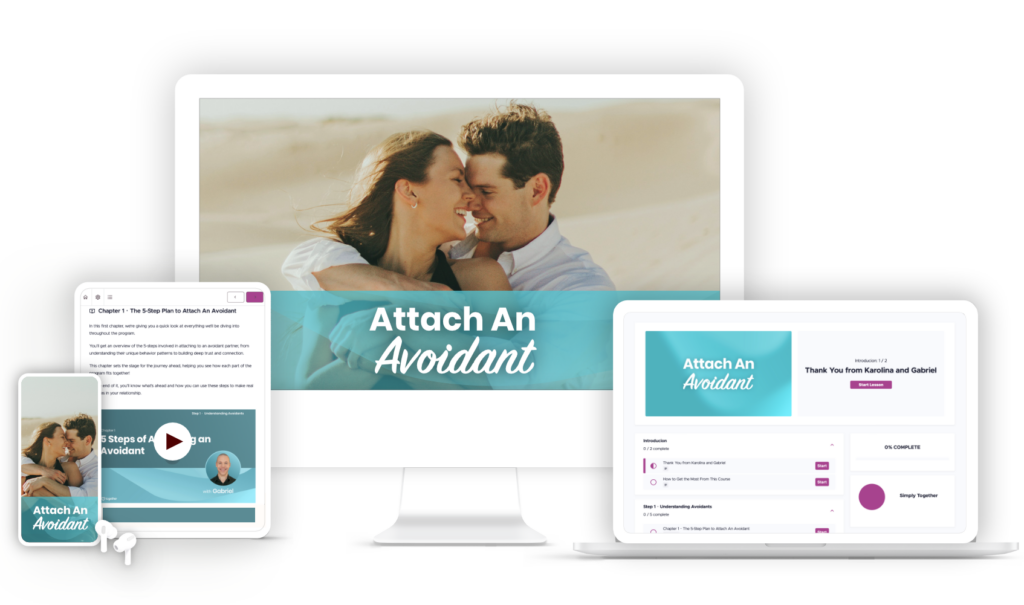
Here I share the avoidant perspective and the definite changes you need to make in your behavior to finally see your avoidant’s behaviors change.
Meanwhile, Karolina will teach you the new approach and mindset you need to turn things around and have that deep connection with them that you know is possible.
So if you want to stop turning in circles and finally see change, click here to learn more about Attach an Avoidant.
Until next time.
Gabriel

- Avoidants Won’t Admit They’re Attached to You, Here’s Why - 18. September, 2025